Recent Cyberattacks: Is Your Business Prepared for Disruption?
Cyberattacks aren’t just about stolen data or compromised passwords. They can actually bring business operations to a halt, disrupt essential services and leave organisations facing significant financial losses.
Recent incidents have shown how quickly the impact of a cyberattack can spread. The last few weeks have highlighted this, a ransomware attack on Japanese cloud provider IDC Frontier affected hundreds of customers. In UK, retailer ASOS also investigated unauthorised activity involving third-party platforms, while a cyberattack targeting French supermarkets caused major disruptions in refrigeration systems, resulting in significant food waste and financial losses.
These are very different incidents, but they raise the same question: how prepared is your business when critical systems become unavailable?
Whilst organisations are increasingly reliant on cloud services, connected devices and third-party suppliers, business continuity is about more than keeping IT systems running. It’s about understanding the risks, protecting critical systems and having the right security measures in place before something goes wrong.
Recent cyberattacks: What went wrong?
IDC Frontier: When cloud services go down
On 7 October 2026, Japanese cloud provider IDC Frontier confirmed that a ransomware attack had disrupted its IDCF Cloud service. The incident affected 495 companies and local authorities, with several cloud zones taken offline.
The disruption also raised concerns about data recovery. IDC Frontier warned that retrieving or restoring data from the affected zones could be difficult, leaving customers depending on their own backups.
For organisations relying on cloud infrastructure, this is an important reminder that even established providers can experience serious disruption.
Cloud service providers offer many benefits, organisations need to be prepared if things go wrong. By having reliable backups and recovery plans in place and a clear understanding of which services they depend on – they can reduce downtime, recover quicker and keep operations running.
For some businesses, a hybrid approach can also provide greater flexibility, allowing organisations to keep critical data and systems on-premise while also keep using cloud services. Combined with strong access controls, such as multi-factor authentication (MFA), this can help businesses maintain control over sensitive information, reduce reliance on a single provider and strengthen their overall resilience.
ASOS highlights the risks of third-party access
In October 2026, ASOS confirmed it was investigating unauthorised activity after users received an unexpected notification through the retailer’s app. The attackers claimed to have compromised a Snowflake instance, referring to the cloud-based data platform used by businesses to store and analyse information. However, Snowflake told the BBC that its investigation was ongoing and that it had found no evidence of its platform being compromised.
ASOS said some basic personal information, including customer names and contact details, may have been accessed, but it did not believe payment information or account passwords were affected. The incident demonstrates why it’s important to distinguish between a cloud provider being compromised and attackers gaining unauthorised access to systems or services from third parties connected to it.
It also highlights a wider challenge for businesses. As more applications and suppliers become interconnected, organisations need to know who has access to their systems, what permissions they hold and how that access is protected.
Coopérative U: When cyberattacks disrupt physical operations – French supermarket attacks
On October 13th 2026, Reuters reported that a cyberattack had affected 80 stores belonging to French supermarket chain Coopérative U. This time attackers targeted connected refrigeration systems, interfering with temperature controls and causing food to spoil overnight.
According to Reuters, the company’s chief executive estimated that financial losses could reach tens of thousands of euros in smaller stores and up to €200,000 in larger supermarkets.
The incident shows that cybersecurity risks extend beyond laptops, servers and business applications – they can also affect physical equipment, especially when systems haven’t been properly maintained, are outdated or are remotely accessible.
For businesses, the consequences can go well beyond IT downtime. Compromised systems can disrupt physical operations, damage stock and affect customers, even when other business systems remain available.
Are businesses getting the security basics right?
It’s easy to focus on the latest cyberattacks, especially when ransomware, cloud security breaches and attacks on connected systems make the headlines. But the lessons from these incidents aren’t necessarily about investing in more complicated security technology. They’re about making sure the fundamentals are in place.
Weak access controls, unpatched systems, excessive user permissions and poorly understood supplier dependencies can all increase an organisation’s exposure to cybersecurity risks.
And while strong security measures can reduce the likelihood of a cyber-attack, businesses also need to prepare for a service or system failures.
That means that businesses need strong cybersecurity measures in place to protect systems, data and accounts from cyberattacks. As well as essential business continuity planning – making sure the business can keep running or recover quickly if an attack or outage happens.
Why MFA matters for business continuity
By requiring users to provide additional verification, MFA makes it harder for attackers to gain access using stolen or compromised passwords alone.
However, authentication is also a critical dependency for many organisations.
If an authentication service becomes unavailable, employees may be unable to access applications and systems, even when those applications are still running.
This creates a difficult situation. Businesses need to restore access quickly, but temporarily weakening authentication controls to keep operations moving could introduce additional security risks.
For organisations using centralised authentication across multiple applications, the impact can be significant.
That’s why authentication resilience needs to be considered alongside identity security. It’s not enough to prevent unauthorised access; businesses also need to make sure legitimate users can continue working when services are disrupted.
Five ways to strengthen cybersecurity and business continuity
There’s no silver bullet for preventing cyberattacks or avoiding downtime. But getting the basics right can make a big difference. From protecting user accounts to managing third-party risks, here are five practical steps businesses can take to strengthen their security and prepare for disruption.
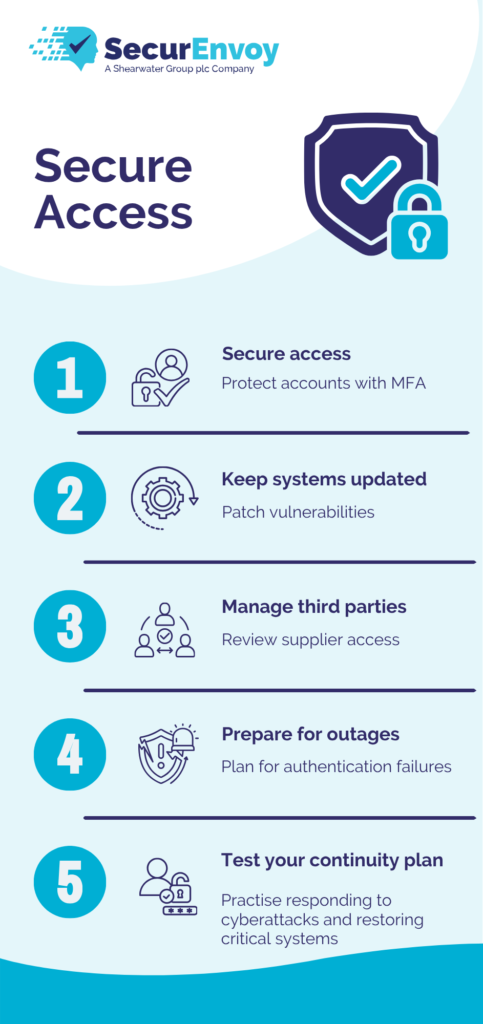
Secure access with MFA
Start by understanding who has access to critical systems and whether they actually need it. Implement multi-factor authentication for employees, administrators and third-party users, particularly where remote access or sensitive information is involved. For higher-risk accounts, consider phishing-resistant MFA, which uses cryptographic authentication methods to help prevent attackers from stealing or reusing credentials through phishing.
Apply the principle of least privilege, regularly review user permissions and remove access when it’s no longer required.
Keep systems patched and protected
The recent attacks on French supermarkets highlight why vulnerability management matters beyond traditional IT infrastructure. Connected devices, remote management systems and operational technology all need to be included in security reviews. Maintain a record of connected assets, prioritise critical security updates and identify equipment that is no longer supported. Where immediate patching isn’t possible, organisations should consider additional controls such as separating critical systems from the rest of the network, restricting remote access and monitoring for suspicious activity.
Manage third-party security risks
Cloud platforms and external suppliers are now essential to everyday business operations, but relying on third parties introduces risks that organisations don’t always control directly. Review which suppliers have access to business systems and data, how that access is managed and what happens if a provider experiences an outage or cyberattack. Ask suppliers about their incident response procedures, recovery arrangements and security controls. Importantly, don’t assume that a supplier’s business continuity plan automatically covers your organisation’s requirements.
Prepare for authentication outages
Authentication is often treated purely as a security control, but its availability is just as important. Review how your organisation would respond if its primary identity provider or MFA service became unavailable. Consider whether cloud, on-premise or hybrid authentication deployments are appropriate for your operational requirements. For some organisations, an on-premise or hybrid approach can provide greater control over specific dependencies. However, the deployment model alone doesn’t guarantee resilience. Redundancy, secure recovery procedures and regular testing are equally important. Ensure emergency access procedures are documented, tightly controlled and tested so that critical operations can continue without unnecessarily weakening security.
Test your business continuity plan
Even with strong security controls in place, no organisation can completely eliminate the risk of an incident. Have clear plans in place for responding to cyberattacks and keeping your business running during disruptions. Make sure everyone understands their responsibilities and knows what to do if critical systems become unavailable. Maintain secure, tested backups and regularly practise recovery procedures. Practising how your team would respond to a cyberattack can help identify weaknesses in your plans before a real incident occurs. The goal isn’t simply to respond to an attack. It’s to limit disruption and return to normal operations as quickly and securely as possible.
Cyber resilience starts with getting the basics right
The recent incidents involving IDC Frontier, ASOS and Coopérative U show how different cyberattacks can affect organisations.
Whether it’s a cloud service becoming unavailable, unauthorised access to a third-party platform or connected equipment being disrupted, the consequences can quickly extend beyond the IT department.
Managing access, keeping systems updated, checking third-party security and testing recovery plans can all help businesses stay secure and prepared for disruptions.
At SecurEnvoy, we help organisations strengthen access security through flexible MFA and access management solutions, supporting different operational and deployment requirements.
Find out more about SecurEnvoy’s solutions.
Published: 27 October 2026
Category: Industry News

Multi-Factor
Authentication
(MFA)
Any user. Any device.
Anywhere.
For companies that take authentication seriously.
Learn more about SecurEnvoy MFA
Hear more from
our security
experts